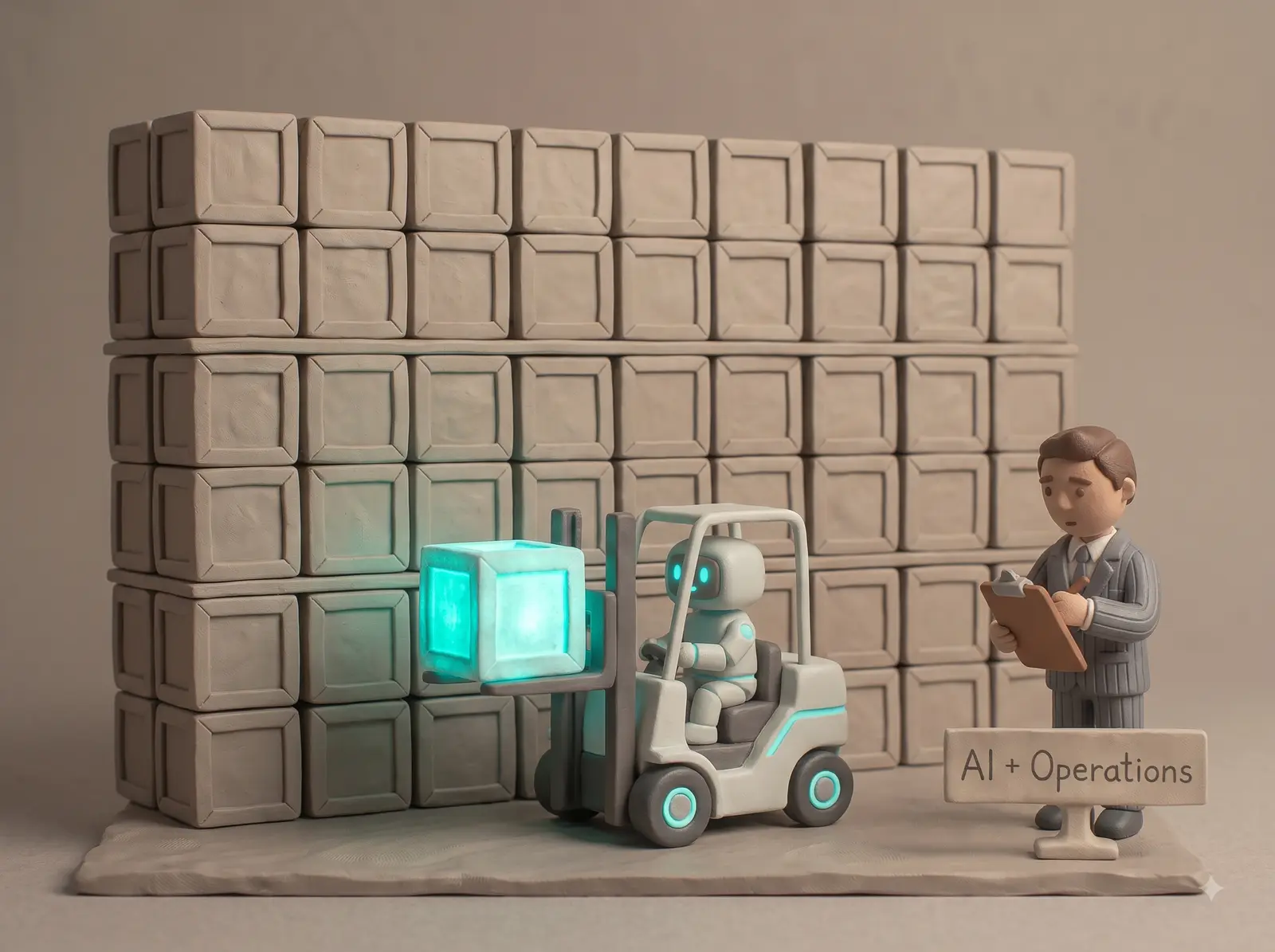
Operations & Supply Chain
Count stock in minutes and see where every shipment is.
Updated 3 weeks ago · 7 sources
Three signs
Does this sound familiar?
Who has already done this
- EnterpriseGather AI
The problem
A major customer wanted more frequent cycle counts than GEODIS's warehouse could handle. Four workers a shift, counting by hand, managed 800 location scans a day and still needed overtime to keep up — and when the warehouse management system didn't match what was physically on the shelf, finding a misplaced pallet took one to two days of searching.
Evidence from GEODIS
A fivefold productivity gain in cycle counting — 1,200 locations scanned per drone operator daily versus 800 by four manual counters.
The takeaway The number that matters isn't "drones are cool." It's that a warehouse worker went from counting 800 locations a day to a machine covering 1,200 — freeing four people to do work that actually needs a human. That's the trade every warehouse automation pitch is really offering.
Keep with a person. Safety, service recovery and operational overrides stay with a person.
How they did it
GEODIS deployed Gather AI's full platform: autonomous drones that read barcodes, lot codes, expiration dates and box counts as they fly the racks, a reconciliation layer that checks what the drones saw against the warehouse management system, and a workflow tool that surfaces the mismatches in real time. No GPS, no new WiFi, no facility changes — the drones navigate the existing racking on their own. One drone operator now scans 1,200 locations a day, against 800 for four manual counters combined. Cycle count time — the time it takes to recount what's actually on the shelf against the records — is cut in half, overtime is gone, and a search for a misplaced pallet that used to take one to two days now takes minutes. "Never would I have thought a drone could do what I was doing, and even faster," said David Ruiz de Arbulo, a GEODIS inventory specialist. "This solution was like a gift from heaven."
- Enterprise
The problem
Uber Freight's own freight audit and pay operation — checking proof-of-delivery paperwork against shipment records before authorizing a carrier payment — required human review of hundreds of thousands of documents a month, most of it spot-checked rather than fully audited, with invoice disputes and payment delays as the result.
Evidence from Uber Freight
A 50% reduction in billing disputes, 100% document audit coverage instead of spot-checking, and roughly 2,500 hours of skilled staff time a year shifted from document-checking to actual problem-solving.
The takeaway This wasn't a chatbot bolted onto an inbox. It was a 12-24 hour manual process rebuilt into four checkpoints a machine runs on every single document instead of a sample — which is why the accuracy went up at the same time the review time went to zero.
Keep with a person. Safety, service recovery and operational overrides stay with a person.
How they did it
Uber Freight built DocAI, which runs every incoming document through four automated stages instead of one human glance: it classifies the document type, extracts the critical data points (PO numbers, delivery dates, addresses), validates that data against the shipment record already on file, and checks compliance requirements like a customer-specific stamp or signature. Rather than one model doing all four jobs, DocAI routes the work across a "council" of several large language models. The system now processes more than 20,000 proof-of-delivery documents a week at better than 99% extraction accuracy, checks 100% of documents instead of the previous spot-check sample, and moved carrier payment qualification from the 12-to-24-hour industry standard down to instant.
- Public sectorPitstop
The problem
Long Beach's fleet — more than 1,600 vehicles and pieces of equipment across public safety, sanitation and public works — was generating hundreds of telematics (the sensor and location data vehicles broadcast automatically) fault codes a day, and Fleet Services had no reliable way to tell which ones needed a mechanic today and which could wait.
Evidence from City of Long Beach
Unscheduled breakdowns fell 20% and vehicle availability rose from 90% to 93% fleetwide, after predictive maintenance software started flagging failing parts days before they broke.
The takeaway The pilot didn't win technicians over with a pitch deck. It won them over with one specific, checkable prediction that came true four days early. If you're rolling this out to a skeptical team, budget for that one moment rather than assuming the dashboard sells itself.
Keep with a person. Safety, service recovery and operational overrides stay with a person.
How they did it
The city ran a two-year pilot pairing Pitstop's predictive maintenance AI with its existing Geotab telematics, starting on a subset of vehicles before expanding fleetwide. Pitstop's models watch battery health, brakes, fuel systems, tires and engine airflow and flag a component before it fails rather than after. "This is just another tool in the toolbox for our staff, and that is how we explained it," said Eric Winterset, Long Beach's Fleet Services Manager — a framing aimed at technicians who were skeptical the software could out-diagnose them. That skepticism broke when a health report predicted a low-battery no-start condition four days before it happened, and the prediction held. After the pilot proved out, the city moved the platform to its full 1,600-asset fleet and gave supervisors and maintenance teams dashboards scoped to the vehicles under their own oversight.
- EnterpriseGather AI
The problem
At NFI's warehouses, inventory turns over three to four times every six months and seasonal staffing swings from five workers to more than two hundred. Manual cycle counts by cherry picker couldn't keep pace with that transaction volume, so the warehouse management system's records quietly drifted from what was actually on the shelf — including pallets that went unrecorded and unnoticed for weeks.
Evidence from NFI
A 75% reduction in cycle count time and a fivefold productivity increase within five months of a single-drone deployment, with more than 15 previously unrecorded pallets recovered.
The takeaway The pallets that had been missing for weeks are the real story. The productivity multiple is the smaller one. A count system that only tells you what should be there is worth less than one that finds what got lost — and lost inventory is money sitting on a shelf nobody can sell.
Keep with a person. Safety, service recovery and operational overrides stay with a person.
How they did it
NFI deployed Gather AI's drone scanning across a facility totaling 51,000 warehouse locations. The drones fly scanning missions alongside live picking rather than requiring the floor to be cleared — the system pauses automatically when a picker needs to access a section and resumes without losing its place. Scan data feeds the warehouse management system continuously rather than in a periodic snapshot. "We found more than 15 pallets missing for weeks in racks but unrecorded," said Ruth Alonso, an NFI operations manager. Cody Merritt, NFI's director of solution design and innovation, credited the rollout itself: "Employees engaged well, delivering a notable 5x productivity increase within five months."
- Learn from thisEnterprise
The problem
Starbucks rolled out an AI inventory tool called Automated Counting across thousands of North American stores in late 2025, meant to scan shelves and automatically tally milk and beverage ingredients that employees had previously counted by hand.
Evidence from Starbucks
So: Pilot a computer-vision counting tool in a handful of stores against one hard accuracy bar — a maximum miscount rate — before it touches every store's backroom routine, and keep the manual count path visible to staff instead of retiring it on day one.
The takeaway Starbucks didn't fail on ambition — automating a manual count is a reasonable goal. It failed on a tool that couldn't reliably tell oat milk from regular milk, rolled out to thousands of stores before anyone confirmed it counted better than the people it replaced.
Keep with a person. Safety, service recovery and operational overrides stay with a person.
How they did it
The system was supposed to save time and give better visibility into store-level inventory. In practice it struggled with accuracy: Starbucks' own promotional video showed the tool scanning a row of syrup bottles and correctly counting several of them while failing to recognize a peppermint syrup bottle in the middle, and workers reported it often miscounted or mislabeled items that looked similar in shape and form, like oat milk and whole milk. Baristas had to audit and correct the AI's counts by hand, turning a promised time-saver into extra work. Less than a year after launch, Starbucks retired the tool, telling stores that beverage ingredients and milk would now be counted the same way as other inventory categories. Publicly, the company said it ended the program "to standardize inventory counting across coffeehouses as we continue to emphasize consistency and execution at scale."
Intracoastal Trucking · 2026-08-17
Intracoastal Trucking runs two-week Tesla Semi demo, projects $0.65 per mile savings
$0.65 per mile in projected savings on maintenance and fuel costs
FreightWavesDohrn · 2026-08-17
Dohrn bets on camera data to cut fleet insurance costs
Accidents have fallen almost 20% since the dual-facing camera conversion
FreightWavesWALTER GROUP · 2026-08-04
WALTER GROUP deploys HappyRobot AI agents across dispatching, payments and support
Five to 10 live use cases across dispatching, payment collections and customer support
FreightWavesAmazon · 2026-08-17
Amazon deploys drones outside U.S. for 1st time
5,100+ flight tests totaling more than 900 hours in the air
FreightWavesSaaStr · 2026-08-17
We Churned Notion After 7 Years. Our AI Agent Took Its Last Job.
0 support tickets over 7 years
SaaStr
Rate any example below — it feeds which ones stay on this page.
Try this today
Turn a supplier's RFP answers into a comparison table
20 minYou see every supplier's answer to the same question side by side, so the gaps jump out.
Copy the prompt
You are a procurement analyst. I will paste the RFP questions we sent out, then paste each supplier's written answers one at a time. Build a table with one row per question and one column per supplier. In each cell, put a short quote or close paraphrase of what that supplier actually said, in their words. If a supplier did not answer a question, write DID NOT ANSWER in that cell rather than guessing. Do not average, score, or rank the suppliers, and do not add information that is not in what I pasted. After the table, list only the questions where at least one supplier gave no answer, so we know what to chase before the next call. Our RFP questions: [PASTE THE QUESTIONS] Supplier answers: [PASTE ONE SUPPLIER'S FULL RESPONSE, THEN REPEAT FOR EACH SUPPLIER]
One check first. A first pass for a buyer, before any scoring. Verify every quoted claim against the original document before you act on it, and check the supplier's contract for what they're actually bound to; the RFP answer is only a promise.
Build a stockout risk brief from this week's inventory report
15 minYou get a ranked list of what is about to run out, before a customer tells you.
Copy the prompt
You are an inventory analyst. Below is an export of current stock levels, average weekly usage, and lead time in days for each SKU (stock-keeping unit, meaning one specific product and size). For each SKU, calculate roughly how many days of stock remain at the current usage rate, and flag any SKU where the days of stock remaining are less than the lead time as AT RISK. Rank the AT RISK list from most urgent to least. Do not recommend order quantities, and do not assume seasonality or demand changes I have not told you about — use only the usage rate in the data. If a row is missing a lead time or usage figure, list it separately under MISSING DATA rather than guessing a number. Data: [PASTE THE EXPORT: SKU, CURRENT STOCK, WEEKLY USAGE, LEAD TIME IN DAYS]
One check first. A screening pass, before any reorder plan. It assumes flat demand, so check anything seasonal or trending by hand, and confirm the lead times are current before you act on the ranking.
Draft a vendor risk questionnaire before a new supplier call
15 minYou walk into a first call with a new supplier knowing which questions matter for your risk.
Copy the prompt
You are a supply chain risk analyst. I will describe what we are buying, roughly how much we plan to spend with this supplier annually, and what would hurt us most if this supplier failed to deliver. Based only on what I tell you, write ten questions to ask this supplier on our first call, covering: single points of failure (do they have a backup plant or route), financial stability, how they handle a missed delivery, and what happens if we need to exit the contract. Do not include generic questions unrelated to what I described. After the ten questions, mark the three you think are most important given what I told you, and say why in one sentence each. What we're buying and why it matters: [DESCRIBE THE PRODUCT/SERVICE, ANNUAL SPEND, AND WORST CASE IF THIS SUPPLIER FAILS]
One check first. A prep list for a first call, before any risk assessment. Have someone who has actually run a supplier audit review it before you rely on the answers to make a sourcing decision.
The tools they used, and what to ask before you buy
Before you buy, ask your planning, transport, warehouse or asset-management vendor what is already included.
| Tool | What it does | Setup | Best fit |
|---|---|---|---|
| Gather AImid-market to enterprise, priced per facility | Sends autonomous drones and forklift-mounted cameras through a warehouse to scan barcodes, lot codes, and box counts, then reconciles what it sees against your warehouse management system in real time. | WeeksIT sign-off | You run a warehouse with racked pallet storage and a customer or auditor demanding more frequent, more accurate counts than your current headcount can deliver.Skip it ifA small stockroom you can walk and count by eye in twenty minutes doesn't need a drone fleet. |
| Pitstopmid-market to enterprise, priced per vehicle | Reads live telematics data off your vehicles — battery health, brakes, tires, engine airflow — and flags which ones are actually about to fail, days before the breakdown. | WeeksIT sign-off | You run a mixed fleet of a few hundred vehicles or more and already have telematics hardware installed.Skip it ifNo telematics on your vehicles yet. Get that in place first — Pitstop has nothing to read without it. |
| project44enterprise | Pulls GPS, ELD (electronic logging device), and carrier data into one feed so you can see where every shipment actually is, and flags disruptions before they blow a delivery window. | MonthsIT sign-off | You ship across multiple carriers and modes and need one screen instead of five carrier portals.Skip it ifYou run one lane with one dedicated carrier who already gives you live tracking. You're paying for a network you don't need. |
| Kinaxisenterprise | Runs demand and supply planning as one continuously updated model, so a change in demand, a supplier delay, or a factory slowdown shows up as a re-run plan within minutes instead of the next planning cycle. | MonthsIT sign-off | You run a complex, multi-tier supply chain — several plants, several suppliers per part — where a single delay cascades.Skip it ifOne product line, one supplier, one warehouse. A shared spreadsheet is still faster to set up and cheaper to run. |
Questions to ask before you buy
Gather AI — 7 questions to ask them
Also used by. GEODIS, NFI
- What's your measured accuracy on a facility with racking like ours, and who measured it — you or the customer?
- Does the drone operate during live picking shifts, or only when the floor is cleared?
- What exactly happens to the count data if our warehouse WiFi goes down mid-scan?
- How much does a misread barcode or damaged label change your reported accuracy?
- What's the actual onboarding timeline for one facility, start to first usable count?
- Which customer is running a facility our size, and can we call them without your team on the line?
- What's the total cost including drone hardware, software, and any per-scan fees, for our first year?
Pitstop — 7 questions to ask them
Also used by. City of Long Beach
- How many days of lead time do you actually give before a predicted failure, on average, for our vehicle types?
- What's your false-positive rate — how often do you flag a component that turns out fine?
- Does this replace our existing preventive maintenance schedule or run alongside it?
- What telematics providers do you integrate with, and does ours already qualify?
- Who on our team needs to act on an alert, and what does that workflow actually look like day to day?
- What does the first year cost per vehicle, all in, and what pushes that price up?
- Can you show us a fleet our size that ran a pilot and walked away — what didn't work?
project44 — 7 questions to ask them
Also used by. Walmart, Amazon, Unilever
- What percentage of our actual carrier base do you already have live data feeds from?
- When a carrier doesn't report GPS or ELD data, how do you estimate the ETA, and how far off is that estimate typically?
- What's the real onboarding time to get our top twenty carriers reporting live data?
- Can your alerts feed our TMS (the software that plans and books our freight), or is this another screen to watch?
- Is disruption prediction included, or a separate paid tier?
- What happens to visibility on a shipment the moment a carrier drops off your network?
- Which customer runs a comparable mode mix to ours, and what did they say broke first?
Kinaxis — 7 questions to ask them
Also used by. Procter & Gamble, Ford, Unilever, Lockheed Martin
- How long does it take a real supplier delay to show up as a re-run plan, end to end, in a live deployment our size?
- What data do we have to clean up before this is usable, and how long does that usually take?
- Which of the AI-driven planning features are live today versus still in early access?
- How does the system decide which scenario to recommend, and can our planners see and override that logic?
- What's the total first-year cost including implementation, and how many of our people does it need full time?
- If we leave after two years, what do we get back, and what does switching cost us?
- Which customer scaled back their deployment after going live, and why?
The questions people keep asking
- Aug 2026
Best AI for warehouse inventory counting right now?
The real contenders are all drone- or camera-based: Gather AI, Verity, and Corvus Robotics. Gather AI can scan during live picking shifts; Verity operates only at night when the floor is clear, which some warehouses prefer for safety and others can't spare the hours for. Corvus Robotics reads barcodes only, with no lot-code or expiration-date capture.
What to watch for
Every public comparison here is written by one of the three vendors about itself. Ask each for a reference running a facility your size and your racking type, and ask what got missed.
Also worth a look. Gather AI, Verity, Corvus Robotics
- Aug 2026
Is AI going to replace supply chain planners?
The evidence so far says no. Adoption survey data shows most companies are still at the machine-learning-forecast stage, a long way from AI agents, and the recurring theme in trade coverage is planners spending less time building the baseline forecast and more time deciding what to do when it's wrong.
What to watch for
The anxiety is real, but the trade press consensus is reshaping over replacing — planners doing less baseline forecasting and more exception handling. Ask what your own planners spend their week on before believing either extreme.
Also worth a look. AI recommends, a planner decides, Full automation of routine replenishment only, No real change yet — most teams are still on spreadsheets
Who to read on this
FreightWaves
Freight and logistics news outlet covering trucking, freight tech, and supply chain AI daily.
daily · publication
Why them
First to report most freight-tech deals and runs its own annual AI Excellence in Supply Chain Awards, judged against real deployment numbers.
Supply Chain Dive
Trade news outlet covering supply chain strategy, technology, and major company deployments.
daily · publication
Why them
Reports failures as readily as launches — the Starbucks AI inventory story on this page came from them.
Logistics Viewpoints — Steve Banker
Steve Banker leads supply chain and logistics research at ARC Advisory Group and writes the site's Monday column.
weekly · blog
Why them
Decades of hands-on supply chain planning and transportation research, and openly skeptical of vendor claims that don't hold up.
Talking Logistics — Adrian Gonzalez
Adrian Gonzalez, founder of Adelante SCM, interviews supply chain and logistics leaders on a weekly video talk show.
weekly · video
Why them
Long-form conversations with the people actually running deployments.
Supply Chain Management Review
Trade publication covering supply chain strategy, technology, and planning practice.
weekly · publication
Why them
Deep, practitioner-written pieces on where AI planning claims meet real operational constraints.
Modern Materials Handling
Trade publication covering warehouse and distribution center technology, from conveyors to computer vision.
weekly · publication
Why them
Closest coverage to what actually runs on a warehouse floor, including the automation projects that get quietly shelved.